// Case study
Qantas Holidays
0→1 at speed—greenfield to full business unit, winning the ideal customers and market share in a fiercely competitive space
Jan 2019 – Jan 2021
// 01 — problem
Problem
In an already fiercely competitive market, prove the case and ship end-to-end with a tiny team and legacy constraints—or don’t ship at all.
Qantas Hotels wanted to grow average order value (AOV) from mostly 1–2 night business stays. The idea was to move into the luxury leisure market—longer trips to lift the AOV and expand the Qantas experience into broader markets, but that space is fiercely competitive.
Qantas Holidays was the greenfield bet: a 'corporate startup' inside the airline, with backing but no room to waste time or money. We had to prove the business case, ship an end-to-end product, and scale up cross-functional capabilities—across marketing, flight & hotel offer search, checkout, partnership, and booking integration.
We kicked off with a small core team—myself as lead product designer, a product manager, and a tech lead, working with limited resources and technical constraints. The only way through was to validate early and ship in phases, not wait for a perfect build.
// 02 — solution
Solution
Validate with Wizard of Oz MVPs, pivot to “digital concierge,” and design ahead of the API and dependencies so we kept shipping.
We didn’t wait for a perfect build. I led strategy, research, UX/UI, and design ops and we used a phased approach to validate fast.
Wizard of Oz validation
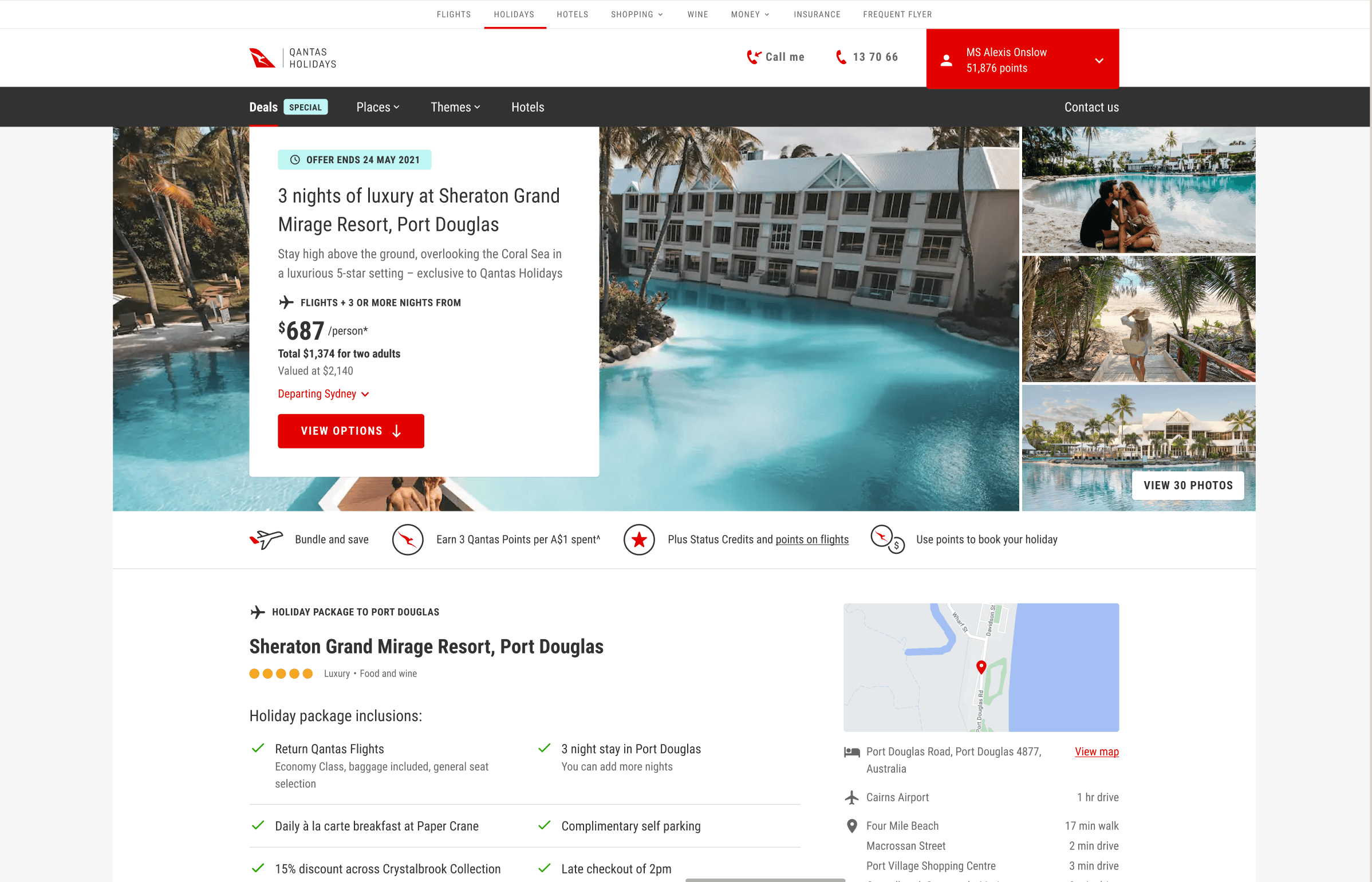
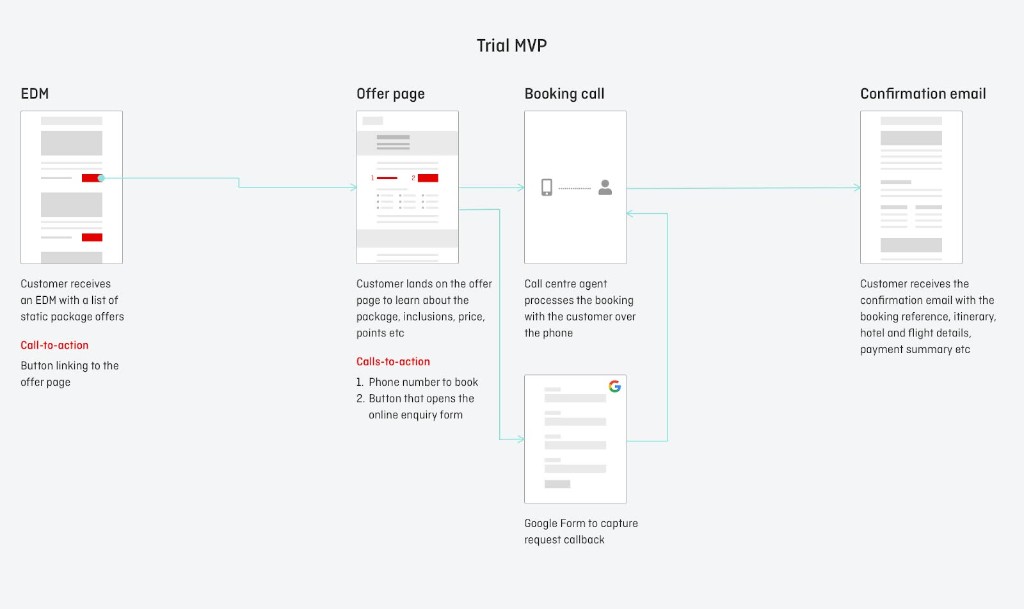
MVP 1 was static CMS pages plus a Google Form for bookings that I designed. The high-fidelity visual storytelling to validated the Qantas brand alone could attract luxury leads.
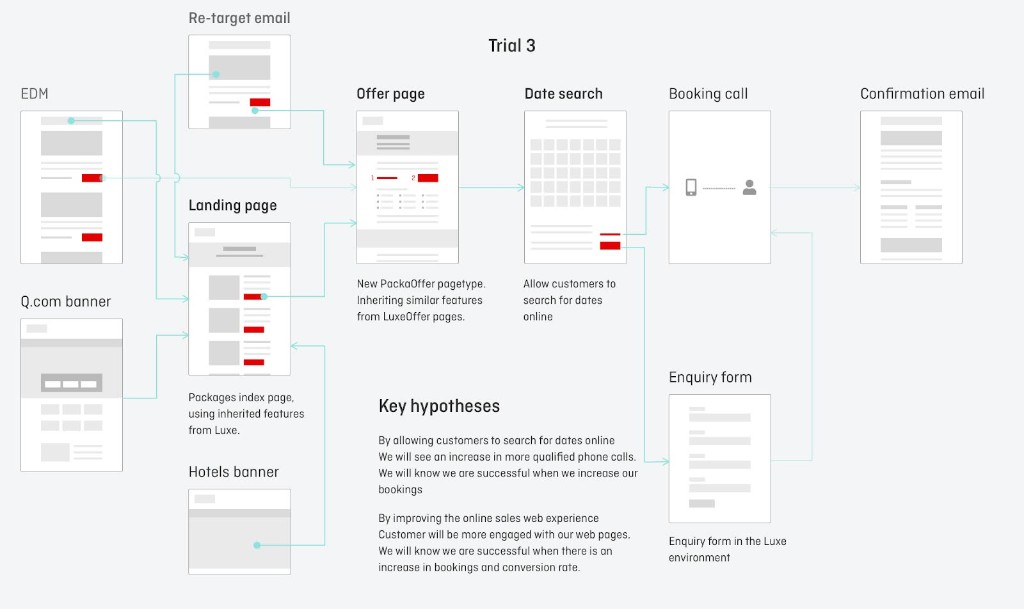
MVP 2 added a availability search calendar UI and showed 'Points + Pay' value before users hit the manual booking wall.
Throughout the MVP phases, I spent time in the call centre and ran interviews to pressure-test our value proposition. The insight that shifted the product:
- Customers weren’t chasing the cheapest deal; they wanted to feel looked after.
- We pivoted from “search engine” to “digital concierge” and framed the proposition around Return on Emotion, with price being only one of the many puzzle pieces.
Taming technical ambiguity
The flight search API (Amadeus GDS) was still under technical discovery. I designed a “Flex-State” UI so that however flight and hotel inventory came back from the API, the front-end stayed premium and uncluttered.
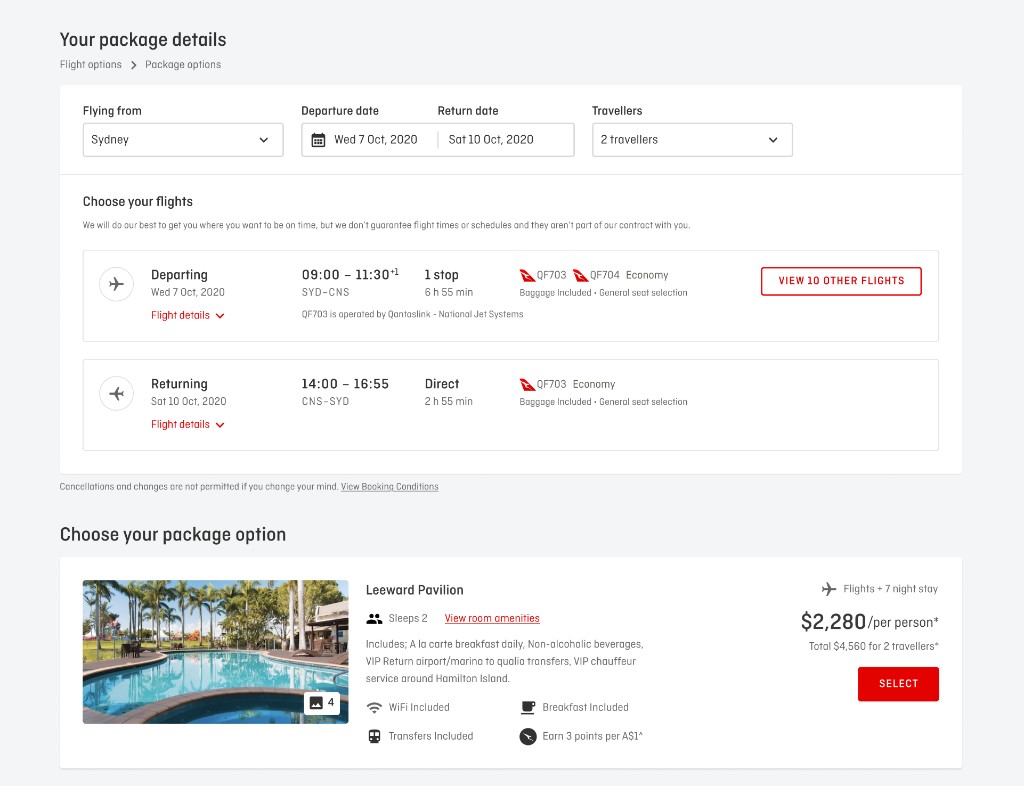
I designed with progressive disclosure—simplifying raw data complexity and surfacing prime times and luxury inclusions—so the experience stayed a clear “yes” instead of a technical maze.
Designing ahead of dependencies
As the sole designer collaborating with teams of engineers across frontend, backend and API, I had to design faster than the dependency. When the core checkout team lagged, I did anticipatory design: mapped their design principles, adapted into our flight+hotel package rules, and delivered a future-proofed checkout that shipped on time of our roadmap.
Future-proofing the platform
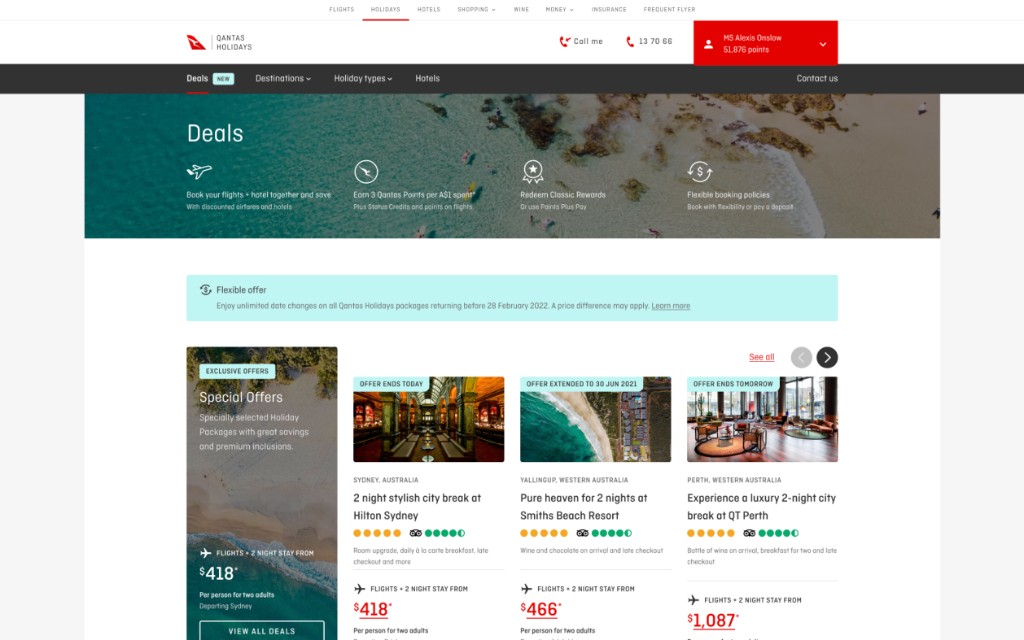
We didn’t just ship a product—we were buiulding a platform that could scale to future opportunities (cruises, tours, experiences) and complement Qantas’ brands, so expansion wouldn’t mean starting over. I jammed with the team leads on the future visions, and designed concepts to show what the future could be through visuals.
// 03 — results
Results
MVP to full business unit in under a year—with growth during COVID and the right customers in a fiercely competitive market.
We demonstrated 0→1 at speed, high return on investment. From a standing start (three people: me, PM, tech lead), we turned a modest MVP into a fully fledged solution in under a year. The return was beyond just revenue—it was in-house capability and market significance.
We launched the brand during the pandemic. While competitors wound down, we found hidden opportunities and doubled down on customer safety with guidance from Qantas’ in-house scientists. I quickly pivoted and prioritized enhancing the design for customer acquisition touchpoints, such as improving search and landing pages. Sales continued to grow.
Scaling capabilities
We earned our place in a highly competitive space and grew into a living business unit with multiple teams. We didn't just build, a web app but scaled up in-house capabilities across:
- Marketing campaigns
- Broad API integrations across:
- Flights GDS
- Multiple hotel inventory managers
- Booking management
- Customer support
- Qantas Points and Loyalty integration
- Payment across multiple methods
As lead product designer, I've designed the best possible user experience across the customer touch points by collaborating with cross-functional drivers.
Product impact
Validation and launch confirmed the concierge hypothesis: premium travellers booking high-AOV packages, strong Points redemptions, and a move from manual Google Forms to a fully integrated, automated booking engine. I shared my learnings with other teams, and some of Holidays' design patterns were adopted into other products.
Scalable platform for future expansion
We built a foundation that could extend Qantas Holidays into new products and complement Qantas’ other brands—from cruises and tours to excursions and experiences—without starting from zero each time.
I designed many concepts to visualize the stakeholders' ideas for our platform to support a diverse range of deals—showing how Qantas Holidays can become the go-to hub for luxury holidays.
// 04 — lessons
Lessons
In a fast-changing user experience landscape, the highest leverage is systems that empower others; premium UX is curation; and leading means knowing when to polish versus when to ship to learn.
- Systemic design in a fast-changing world. The highest-leverage output wasn’t individual screens—it was the system (backend services, patterns, constraints, rationale). By understanding these systems, I designed patterns to let engineers make good low-level design decisions, without design as a bottleneck, so I can focus on high-impact strategic and vision designs.
- The luxury of clarity. Premium UX here was curation: removing cognitive load so people felt looked after, and present options that appealed to their desires. By de-coupling the UX and system layers, I could design a curated experience for Qantas customers, as well as advise the Jetstar team to curate an entire different experience, all using the same underlying system.
- Strategy over specs. Leading meant knowing when to push the visual bar and when to ship a “good enough” MVP to get the data that unlocked budget and insight. Ship fast, learn fast, so I can focus my craft on making optimum impact.